Showing posts with label Drama. Show all posts

Saturday, August 21, 2021

Pig (2021)

SPOILERS for the movie in here.


Director: Michael Sarnoski
Starring: Nicolas Cage, Alex Wolff

Food is such a fraught, weighty thing; it can be political and it can recall all these memories and mean so much to people. In Nicolas Cage’s new vehicle “Pig” these kinds of themes are explored. Cage’s character Robin Feld, an ex-chef who now lives a solitary life in the woods, has a line maybe two-thirds of the way through that really encompasses everything the movie is: “You only get so many things to care about.”

Most of the rest of it is just this tour through the strange and seedy world of the restaurant underground. It’s a curious backdrop for a film and endears me to it – this wholly singular kind of plot and setting. There’s some pretty wild and ugly things that go on like an underground fight club for cooks? I want to know how much this is based on real life. Something tells me there has to have been some real-world connection there. Then you get the more artificial side of the actual front-facing restaurants, so fussy and over-prepared that there’s nothing real in it. All of it really ends up showing you why someone might end up leaving that life.

But he’s got to go back in though. Someone’s taken his truffle pig. He and Alex Wolff’s character Amir, who is trying to start his own business in this crazy culinary underworld, end up on a tour of said underworld, as Robin tries to figure out what the hell happened.

It’s all very moody and somber and the movie doesn’t spell anything out for you. Cage is remarkably restrained and his killer stare does a lot of the work as he chooses his words very carefully. When he does speak it’s like a thunderbolt. You fucking pay attention. Wolff’s character talks tough but he also talks too much and betrays that maybe he’s not as worldly as he wants to be.

Robin goes through this whole thing with a cloud of impending violence over him. But the violence never really comes. There’s one scene with the fight club I mentioned where you get some pretty grisly stuff comparative to the rest of the film, but everything else tends toward the quiet. One of the best scenes is when he visits his old restaurant – now a bakery – and has this really short, tender exchange with the lady who’s taken it over. He gets some baguettes. It doesn’t sound exciting but like I said – food has layers and layers of meaning for people.

Eventually he finds out who took the pig – Amir’s father, played by Adam Arkin, who is now some kind of big kingpin in the Oregon culinary world. Arkin apparently ordered the pig stolen to do what his son was doing selling the truffles but even better. It’s pure capitalistic bloodthirst. No real regard for the humanity. Robin and this guy commiserate just slightly on the fact that they’ve both lost their wives. In an earlier scene Amir had said Robin once cooked a meal for his (Amir’s) parents that they talked about for years after. Unlike your usual “who took my (x)” Taken/John Wick sort of film, there’s no big beat-em-up action scene. Instead Robin cooks the same meal as he’d done years before – he says he remembers “every meal he’s ever cooked, every person he’s ever served.”

Killing the other guy with compassion. Reminding him of what was lost and what matters in life. It’s genius. I wish I had thought of it. The underlying theme speaks to me of the human connection that really matters more than anything else. It sounds like something obvious, but stripped to its core with how the movie presents it, and especially with the raw, quiet ending - it comes off profound. At the end of the day, by the time the last line tells you Robin's deceased wife had given him the pig as a gift and that's why he's so hellbent on getting it back - you kinda guessed that by then, but the emotional effect is as resonant and heavy as an obelisk anyway.

The whole thing really comes out to a grand piece of film. It’s quiet but the themes and ways these characters are unveiled comes out to something that the greatest movies are all about. Mightily human and vulnerable stuff. The reason you go to the movies. Don't miss it.

Sunday, September 17, 2017

Mother! (2017)

Darren Aronofsky's Mother! isn't a film I liked much at all, but one thing you have to give it is that it's worth talking about. At the very least, it's interesting – so I guess I'm saying this is the cinematic equivalent of a guy wearing a clown costume and alternately blowing a trumpet while screaming Bible verses on the street corner. It's annoying and pretentious, but at least it isn't boring.


And yeah – there are gonna be SPOILERS in this one!


To be fair, there are some decent parts to this... the directing is nice and can have a rather uncomfortable claustrophobic feel to it, and the acting is good. The first half or so is a decent enough curiosity, telling an odd story of a couple trying to keep up a perfect house and stalled writing career when a stranger (Ed Harris) comes to the door and ends up staying with them. Everything is creepy and foreboding enough that you want to see where it goes – though later on, when the guy's wife shows up, it turns out the scariest thing in the movie is really just marital insecurity over whether or not Jennifer Lawrence and Javier Bardem are going to have kids.

Mostly, the tension in this comes from how much everyone treats Lawrence like shit – her character is just constantly stepped on in this. It's revealed that Ed Harris is a big fan of Bardem's poetry, I guess – and he's also dying of cancer.

Then things take a bizarre turn when Ed Harris's two psychotic sons come to the house and have no problem at all getting into a violent fist fight over their father's will, or some shit like that, and it ends as one of them kills the other. Bardem and the family go with him to the hospital while Lawrence cleans up the blood. What a good wife she is. I would have just fucking left.

And this is really where the movie starts to lose me and the problems start to become apparent. What happens next is a pretty crazy parade of people who know Ed Harris' character come and stay at the house to mourn the dead son while waiting for the funeral. They partake in all kinds of merry funeral activities like having sex in the bedroom, having sex on the stairs and trying to have sex on an unstable kitchen counter that explodes through the wall and rains sewer water everywhere – just good that these assholes are keeping things proper for the funeral mood. They have no logic or reason to it of course; they're just unrealistically nasty, because they have to be for this to work at all.

Lawrence, after like 20 minutes of screentime trying to get them to calm the fuck down and listen to her, finally melts down and screams for everyone to leave. I guess this was all it took. Why didn't she just lose her shit earlier then? Apparently that's the only thing these people will respond to. Not the dead guy they apparently knew – just a random woman losing her shit.

But seriously – this is one of the movie's problems, honestly. I just can't see the character or logic in what she's doing here. She's way too passive about everything. And I know – it's the metaphor of it all, about how she's supporting her husband even though it's tough. But that just doesn't make a good movie for me. Her actions, and the plot as a whole, only seem to exist to serve the metaphor. Everything is just about that message; there's no actual insight into the character. Lawrence is just moved around like a chess-piece so Aronofsky can say look at this message I have, and while all fiction is sorta like that, it really does come off as too transparent here. It's just too easy of a story when you can handwave away anything by saying it's the message! I just find stories more interesting when they're well-constructed around how people actually act in the modern civilized world around each other.

Then things get even worse and more insane when Bardem completes his work of poetry and then, without apparently sending it to anyone or advertising, people begin coming there on a pilgrimage to worship him for his art, even going so far as to set up churches and start treating him like a God. And before you get any crazy ideas, no, this has nothing to do with how Aronofsky sees his own art...

Things do get slightly out of hand when bombs start falling on the house randomly and people get lined up and executed like some kind of African jungle war prisoner ritual or something. Yes, I'm serious – you didn't click into another movie review. It's all very over the top and, while it's entertaining for how batshit crazy it is, you start to check your watch after a while. How long is this gonna go, anyway? I'm an American – we see this shit on TV all day.

Lawrence has the baby and Bardem insists on taking it from her to show to the raving hordes of religious nutballs who now worship him as a God. Within like, a few minutes, they tear the baby apart and eat it, which I am really curious if they got the anatomy right. We should consult some scientists. It would be a shame if the movie got this part wrong – would totally ruin its credibility.

Lawrence, after she gets the shit beaten out of her in a gruesome scene even I have to admit was effective, burns down the house and finally kills everyone except for herself and Bardem – curiously without a scratch on him. He carries her through the house burnt to a fucking crisp, and then takes her heart, the last thing she has left to give him.

Then it turns out Bardem is actually using her heart to restore his entire home to exactly how it was before - he is some kind of vampire or something, I guess, and while I get what the movie is saying here, about artists feeding on others' generosity, it is kind of funny, you have to admit. I think it's humorous that this is how this movie ended.

And I get it, okay – I get the message here. It's saying a lot about the tenets of marriage, especially to one so drawn to art, and the differences between how the archetypal Man and Woman act. Some of it is at least passably interesting commentary, not coming off as anything too dumb or base-level.

But there's just no real meat to this as a movie – all there is is the message. Everything is totally in service to that message. And that means basically nothing that actually happens in the movie has any significance. It's all just metaphoric, anyway; every bit of what happens. The rude people treating Lawrence like shit, the bombs falling, the execution, the eating of the child – it all just passes over with the airy, transparent feel of a ghost, because it doesn't matter. Nobody talks about the repercussions behind any of it, and the people don't act like real people, because they're all just chess-pieces and mouth-pieces for Aronofsky's message. It all exists only because Aronofsky needed to get a point across, which consequently comes off extremely heavy-handed.

I just find this a dull, almost immature way to write a movie. Personally it didn't gel with me. I know some people really liked it – such is the nature of taste. I like movies that treat the characters as more nuanced and complex beings. This one didn't do that for me.

Image copyright of its original owner; I don't own it.

Saturday, August 19, 2017

Cinema Freaks Live: A Ghost Story (2017)


Here's our Cinema Freaks Live video for the movie 'A Ghost Story.' I've been preoccupied with other things like the pursuit of money to pay bills and shit lately. So I hope this will tide people over. More reviews soon!

Saturday, July 2, 2016

Orange Is The New Black's Season Four & the Viewer's Prism - SPOILERS

The new Orange is the New Black season is probably the show's most audacious and challenging yet. I say that because there were parts of this that were awful and gut-wrenching to watch. This is challenging, forward thinking TV, and yeah, there are going to be some SPOILERS in this thing, so if you don't want that, go back on Netflix and finish the show.


I guess I'll just address the elephant in the room immediately, with Poussey Washington's death in Episode 12, “The Animals.” It's a horrible thing to watch, her being suffocated on the floor, and notably by Bayley, who was the most harmless looking, innocent seeming guy prior to this – that's really, really something, I think.

The thing for me was that I didn't know how to feel – Poussey's death was a tragedy, and Bayley was responsible yet is not some kind of evil psychotic monster like some of the other guards. That's important. Several characters on the show in the last episode – Caputo and Coates most notably – talk about how prison changes you, how Bayley is ruined after that. And obviously, that's the complete wrong reaction to have – like in the case of the Stanford rapist, talking about his life when another person has died (or in the Stanford case, been raped) because of him is unspeakably shitty. But Bayley isn't portrayed as some kind of evil monster either. His actions are awful and what happened is awful, because he's a moron who wasn't good at his job. He feels bad and he should fucking feel bad. But he isn't written as some kind of cartoon villain monster like he would be in other shows. It would be cheaper if he was written that way. He had to be a fully fleshed out character.

It's just a shitty situation. And the show does well at testing your moral compass and then smashing it up and throwing it into a blender.

The flashbacks in the episode are about Bayley basically going through life as this moron slacker kid. Getting thrown in jail for drinking on top of a water tower, getting fired from a job for giving free ice cream to girls. It's all inconsequential goofy petty bullshit that happens and none of it means a thing, because he's an upper-middle-class white kid and the world's his oyster. Even when asked why he's working at the prison, his answer is to shrug and say he's here “until the next thing.” Nothing has any meaning and he's just this aimless loser who gets by because he was born in a pretty privileged area and had a decent life up to now. He doesn't look like the kind of guy who'd kill someone, so when he does without meaning to, its his future and well being that are worried about – not that of Poussey or her friends, family, or the general injustice of it all. Infuriating shit. It's supposed to be – you're supposed to be mad at this.

The finale is even more gut wrenching – we see Caputo and the MCC PR people floundering desperately, Poussey's body left for hours on the kitchen floor while they try to spin it their way. Caputo, who has talked a big game all season about really helping these inmates and being there for them, can't do anything – he's paralyzed and his actions come off as cowardly. He's a fairweather friend of sorts, with good, charitable intentions during the good times, but then unable to do a thing during the bad solely from his own incompetence. And then again, how can we blame him? Any major insurrection against MCC would lose him his job and then nothing would ever change at all. He's doing what he can. But as in real life, doing what one can isn't always enough and it won't always matter a damn.

The show excels at creating these situations that are so morally complex that there is no right answer and people will view them through different lens. It's easy and valid to say that Caputo's a piece of shit and Bayley is trash and the flashbacks about him are unnecessary, because a person died, a black person, who are so often victimized by police in real life. It's also easy to say that they're all doing their best and things are fucked either way and nothing is simple. That's valid, too.

The show is a sort of reflective mirror-prism for how you look at any number of situations in life. Not everyone is supposed to find this season pleasant or easy to watch. I think that is what makes it great art, and what puts this show up there with Breaking Bad and The Wire for groundbreaking TV that portrays the human experience. I've read a handful of editorials from black viewers who absolutely hated this season:

http://jawnbaejaeger.tumblr.com/post/146175495753/every-white-person-talking-about-how-poussey

http://wearyourvoicemag.com/more/entertainment/orange-is-the-new-black-trauma-porn-written-white-people

http://verysmartbrothas.com/yeah-im-finished-with-the-black-suffering-trauma-porn-of-orange-is-the-new-black/

They are perfectly justified in doing so. Why wouldn't they? It more directly affects their community. It talks about a problem they deal with every day and which is so much more real to them. Expecting them to react to Poussey's fictional death in the same way as someone like me is farcicial. It's never going to happen. I don't know shit compared to them.

So, like I said – the mirror-prism thing. Your view of this sequence of events in OITNB is solely dependent on your view of the real life things going on. Some people won't like this stuff because it's uncomfortable or it comes off as exploitative, and that's fine, they are perfectly justified. I would never try and patronize them by acting like I know better. I don't. I have no idea what they go through and wouldn't dream of trying to push my worldview on theirs. I'm just a guy myself, seeing this show and I like it because I'm into real life news, and seeing art that portrays things in this manner interests me. But other people have different experiences and they may find this to be offputting. I don't think the show really wanted to please everyone anyway. What it wanted was to show this stuff – to open the window a bit. Let us gaze out.

But as sad as this all is, what you should be taking away is that young black people die at the hands of the law way too often in real life. This is a fiction, but what's happening mirrors things that the black community has faced for real. This is nothing compared to real life. Black lives do matter, and the show's portrayal of these current events is maybe not even necessary when there's so much real evidence of this kind of thing happening. That's the one flaw here. It's ugly, sad and horrific, and there are no punches pulled. Maybe it doesn't need to exist or be shown. I don't know - but it is here. And so I'm writing this.

The show pulls this trick, of testing your morals, over and over again. Sam Healy is an odious man, a racist and a misogynist who uses his position in power at the prison to work out his mommy issues. But he has other dimensions to him and we see the show's portrayals of him as sympathetic in his attempts to find real human connection, to feel good at his job, to help out. He doesn't often succeed, because of his own limitations as a person. Not everyone gets a happy ending. That's realistic. The point of portraying him this way is that even terrible people have dimensions and complexities. Lots of movies and shows don't have anywhere near this kind of insight. Should art only humanize and explore those that are widely considered good and respectful people? It's all fiction at the end of the day. We should use it to challenge ourselves a bit.

Likewise with the perhaps even worse Coates, who raped Pennsatucky last year. He was widely reviled last season. But this year, we see that he feels confused and starts to regret what he did after he learns what Pennsatucky thinks of him – you know, that she isn't just avoiding him to play coy. The fact that a show with such a feminist message and written by so many women is doing this is pretty key here. For one, it's the same thing as Healy, this humanization of a rapist, showing that he's still a person at the end of the day with his own complexities. You don't have to like him. In fact you're probably not supposed to. But his characterization, his humanization shows a different point – rapists are not the shadowy monster in the bushes, and they aren't somehow less human than us, and it isn't okay to feel vindicated or different if you've done something to someone without their consent just because you aren't that old stereotype. Rapists are guys who appear pretty normal from far away. That's what Coates shows.

The fact that the show gets these reactions is what makes it great to me though. I don't think art needs to be likable or palatable to everyone. Better if it's not, even. I want art to surprise and challenge me and make me consider things in ways I hadn't. OITNB does that big time here. That should be the whole purpose of art. People not liking something is fine. With a show like this, it'll be a given. You shouldn't want art to be easily palatable and accessible to everyone, because what's going on then? You're not taking a real stance, you aren't saying anything controversial or exciting or electrifying, and it's harder to come out with something really great if you're just taking the middle of the road and not trying to push any buttons. Does all art have to be likable first and foremost, over any other quality? I don't think it does.

Images copyright of their original owners. I don't own any of them.

Tuesday, April 19, 2016

Why Better Call Saul Season 2 Is some of the best TV this year (SPOILERS!)

Better Call Saul just finished its second season the other day, and I think this is one of the best shows I've seen in a long while. It's a prequel to Breaking Bad, for one thing, and I never thought I'd like a prequel this much. But here we are. I think the secret to this is pretty simple, a sort of Occam's Razor thing: Vince Gilligan and his team just know how to write characters and stories you want to see.


!!!SPOILERS FOR BETTER CALL SAUL SEASON 2!!!

In a lot of prequels, the problem is that the stories aren't compelling – they're just paying lip service to the original thing they were based off of, but explaining really dumb, obvious things that never needed explanations, ruining the mystery and intrigue. Better Call Saul is a prequel in the sense that it's showing how Saul Goodman from Breaking Bad became the hilarious, sleazy, corrupt lawyer he is. But he's a character we want to see more of. I read once, somewhere I can't recall, that the secret to creating a long-lasting character – think Batman, Spider-Man, Sherlock Holmes, that sort of thing – is to make them so malleable that they can fit into multiple situations and you want to hear more stories about them. That's what Gilligan and co. have done with Saul Goodman.

This season has just been excellently done. The first season was good too, though it felt kind of like a first season – underdeveloped a tad and not quite firing on all cylinders yet, so to speak. It introduced Saul as his birth name, Jimmy McGill, and his brother Chuck, who has a sort of mental illness that makes him sick when he's around electricity or any kind of technology. It also introduced Kim Wexler, Jimmy's sometimes fuck-buddy and eventual girlfriend, and the law firm Hamlin, Hamlin & McGill, who Jimmy was trying to work for. At the end of that season, the big twist was that Chuck had actually been sabotaging Jimmy's career, believing his younger brother to be an incompetent con man who was unfit to practice at a real law firm.

The second season took that and just started running with it. Despite the fact that the show wants us to hate Chuck for his lies and betrayal, Chuck wasn't wrong about Jimmy – Jimmy is a con man, through and through. He constantly cuts corners and bends the rules to get what he wants, in this season even crossing over to straight up felony offenses like forging legal documents. He's a likable character and we want to be on his side. But art imitates life – as in real life, con men like Jimmy are only successful when you like them enough to buy into their act.

That's what Gilligan and co. did so successfully with Breaking Bad. They made characters who do horrible things to each other and those around them, but you want to keep watching. Gilligan understands human motivation and human nature. This second season of BCS exemplifies that. Jimmy, for all his (kinda flimsy) attempts to do right and walk the straight-and-narrow, is a criminal at heart. Kim helps him get a job at Davis & Main, a huge prestigious firm. He basically immediately begins to sabotage himself. Unwittingly or not: he doesn't really want to be there.

What I really just love about this season is that it never – never – just takes the easy, shitty path that most shows would take. Despite his reckless and ridiculous behavior at Davis & Main, Kim still likes Jimmy and they work things out like a real couple would. They have their problems – it's not some kind of blind adoration – but they work things out because they like each other. Jimmy gets Kim in trouble with her own firm when he goes behind his bosses' backs and makes a corny commercial without their consent. She's angry at him. But they make up from that, too. A lesser show would have had them exchanging dramatic soap-opera-y shouting matches and swearing they'd never be together again, taking half a season to resolve things in a predictable way, kiss-and-make-up. BCS has them resolve things quickly and quietly because they know you don't just throw out a good thing like that. Real people don't – relationships take work. So these characters don't let their relationship go to waste. It makes for refreshingly candid, unpretentious TV that comes off as rewarding in the way it isn't content with giving the viewers bottom of the barrel entertainment. It doesn't treat the viewers like jackasses or simpletons.


Again, and perhaps more tellingly: the second half of the season focuses on Kim and Jimmy breaking off into their own firm. Kim wants to take this big client from her old job with her, but Chuck and her boss, Howard, take it back by persuading them in a rather underhanded manner. Jimmy, seeing red, breaks into Chuck's house while he's in the throes of a panic attack and doctors his documents, humiliating him in court and losing him the client. In a stupider, less gratifying show, this would have taken many more episodes to play out – a bunch of stalling and game-playing before we see Chuck fuck up in court, and then at least another half a season before Chuck figures out what Jimmy did.

BCS didn't do that. Chuck figured it out the very next episode, and confronted Jimmy about it in the same episode. It's instant gratification, yes, but it's good storytelling. It doesn't keep the promise dangling above the viewer like a mouse toy for a frustrated cat. Breaking Bad was masterful at drawing out its plot and making callbacks to earlier seasons and plot threads at unexpected times. BCS, by contrast, is both simpler and more complex – it gets to the point of a plot thread right away without delay, but everything going on is rife with subtext and hidden character motivations and all kinds of shade and light. It's fascinating, complex writing.

In the finale, the first scene is Jimmy and Chuck in the past, sitting with their dying mother in the hospital. Jimmy pesters Chuck to go with him to get some lunch, as they haven't eaten in a while – she'll be fine when they get back, he says. He ends up leaving by himself, after saying he'll bring Chuck something. Their mother wakes up when Chuck is sitting there by himself, and she calls for Jimmy briefly, who isn't there. Then she dies. When Jimmy comes back and learns that she died, Chuck lies and tells Jimmy she didn't say anything before she died.

That is fucking great. There's so much going on in that sequence – Chuck was, on the one hand, being merciful by not guilting Jimmy and admitting that she said his name before she died, which would have surely made him feel bad for not being there. But on the other hand, Chuck also resents Jimmy because their mother called his name before she died, and as we know from the numerous other stories and tales told this season, Jimmy was a fuck-up all his life while Chuck tried his hardest to succeed in the name of the law. But Jimmy was the favorite. And it killed Chuck; that did. There's so much unspoken in that short three-minute scene that opens the finale.

And again, later on in the finale, we see Jimmy go to Chuck, who has turned his house into a certifiably crazy-looking mess of tin-foil walls to supposedly keep out any electric vibrations, or, well, some shit like that. Chuck breaks down in front of Jimmy, saying he's lost his mind and has to retire from the law because of the mistake he made on the case from earlier in the season. All this finally gets Jimmy to confess – with Jimmy exiting the room by saying it's his word against Chuck's. Chuck then uncovers the hidden tape recorder he'd been using to catch Jimmy confessing on tape.

Again, so much going on. Jimmy's hubris and recklessness are immediately laid bare – the whole “it's my word against yours” thing; wow. Wow. That's nuts that he thought he could just say that, basically flaunting his crime in Chuck's face. He had good intentions, yes – but the fact that he deceived his brother at all and committed a felony speaks volumes as to his character. He's surely put his feet as well as Kim's in the fire now, as the case he confessed to fucking with is the one Kim is currently trying to build her solo law practice off of. If you thought it was impossible for a show to make you care this much about what would in real life be boring legal stuff – well, BCS pulls it the fuck off.

And Chuck, well – part of Chuck's whole rant about his brain being fried and senile was rooted in his own fears. Chuck has done some terrible things in this show, and shown his own egomaniacal levels of conceit, but he's still a human being, and Gilligan and co. don't forget that. When he breaks down and cries that he's losing his mind, it's an act to swindle Jimmy like Jimmy swindled him. But I interpreted that scene as being partially rooted in Chuck's real fear, that he might just be going crazy. That's what I like about this show – no character is just doing one thing. There are always these hidden motivations that make them compelling to keep watching.

Mike's storyline, too – we see him in this season as a less professional version of who he'd be in Breaking Bad. Though he had the 'half measures' story back in Breaking Bad season 3, and we saw the story of why he's in Arizona last season, this year his story is again about him mixing up with criminals he doesn't fully understand and kind of underestimates, too. His parts here are short and often without many words. There's a very cool, pulp neo-Western feel to them. And I like how they're taking it slow with his character – it shows that a person isn't changed completely or defined utterly by one event only. A person is the sum of many different experiences. You can see that in Jimmy's transformation into Saul, too. The layering of these characters is what makes the drama rich and rewarding to watch, much more than just a mere series of suspenseful events happening in sequence.


It's great drama. The way these characters are written, and the way these scenarios play out, make for a cracking, heartfelt drama with depth and shading to match a classical work of art or a painting of some kind. There's no talking-down to the audience and no silly TV-show cliché. What BCS is, is a real work of art and a masterfully unfolding story. The events in this season built on one another like a well-played game of Jenga. Next season, sparks will fly. I'll be there to witness that – will you?

Images copyright of their original owners.

Friday, January 1, 2016

The Room (2003)

This movie has been talked about over and over. It's the Troll 2 of our generation. Something in us is just fascinated by bad, bad movies, and not the kind that ends up boring. No – we like the fucking weird, whacked out bizarre crap that we can't stop talking about. The stuff that has the worst possible, most ridiculous scenes, characters and dialogue. The Room is exactly that, the pinnacle of that.

Director: Tommy Wiseau
Starring: Tommy Wiseau, Juliette Danielle, Greg Sestero

Co-written with Michelle.

If you really don't know, this is a writer-director-actor project by Tommy Wiseau, a fantastic bizarre alien from unknown origins. It's about him playing this guy Johnny, a super great dude who has a vague job that is never explained, and his fiance Lisa, who cheats on him with his best friend Mark. If you don't get that, well, don't worry. There are enough sex scenes in this thing to replace all the porn in your backlog for the next two months.
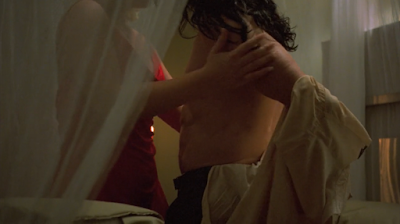
Oh yeah, his man tits sure turn me on.

These sex scenes are, if you never heard, all filmed to the soundtrack of terrible, terrible fucking emo rock songs from the early '00s when this was filmed. Even 14-year-olds going through break ups would hear these songs and say, wow, those songs are fucking terrible. I also love how overly long these scenes are, as it's a great way to develop character. Oh wait, I mean show off Tommy's ass:

I'm sorry, I'm just so sorry...

After that sex scene which was longer than most actual sex scenes in real life, we get Lisa talking to her mother, Claudette. Lisa, despite acting like she liked Johnny before and having passionate sex with him, now says she doesn't love him and she wants to break up with him. Her mom is a pastiche of 1960s sexist cliches, spouting off about how Lisa can't provide for herself and needs Johnny's income to survive. I get the idea this woman has had about five past husbands, all of them having died mysteriously.

Oh, and there's one scene where she casually admits she has breast cancer and is dying. This is never brought up again, and nobody ever seems to care. It's literally never even mentioned again after this one scene. It's so backwards and wrongheaded, I'm tempted to think it's actually a brilliant commentary on something. But then again, that's what I say every time I see unspeakable and callous cruelty, so what do I know?


Johnny himself is a marvel, a man who can seemingly barely keep his fucking eyes open, while at the same time being able to hold down a job that keeps him busy all day, multiple friends who all love and revere him, and of course somehow he got Lisa, who was apparently a great person who would wait around for him all day and fuck him as soon as he got home, until recently when she decided she didn't love him for no reason. Phew. I need to take a breath. Most of the time, Tommy Wiseau looks like he is about to fall asleep on camera.


There's also Denny, a mysterious man child, anywhere from 19 to 35, who constantly appears in the doorway like a phantom. In his first scene, he enters their apartment without knocking or asking, says he wants to hang out, and they immediately go upstairs to fuck. He follows them, because what ARE social cues anyway? Are they ancient relics from a distant past? I guess it's pretty rude for them to go upstairs and have sex the second he comes over, but can you blame them for being in the mood? Look at that face:


And after they go upstairs, this happens, because we didn't have enough reasons to fear this character yet:

What the hell? Isn't this the kind of behavior and look of a man about to commit a murder-suicide? "He was a quiet man, so normal..."

Denny is the human mystery. He is the missing link. He is the reason mankind can't make sense of anything at all and can't find a true link with God. And he's here, in this movie. He is the one who holds all the secrets of the universe, and they can be found in his dead eyes as he stares at the moon each night with emptiness and nothing in his soul. He will be here long after the rest of us are gone. Denny is the alpha and the omega.

The movie is full of characters just appearing at random in rooms after previously not being there. The dialogue is all written as if spoken by a space alien who originally learned Cantonese and is now being forced at gunpoint to read an English sentence. The scenes just repeat and repeat, like some kind of horrible Ouroboros nightmare: Lisa has sex with Johnny or Mark, and then bitches to her mom about how she doesn't love Johnny. But she can't call it off because she doesn't want to be mean. So she'll just keep cheating on him instead, y'know, like a nice person. That one sequence happens like, six times within the first hour of the movie. It's like the characters are stuck in an endless loop. They might be in Hell.

Oh, and there's one scene where Denny has a run in with an extremely tall, menacing drug dealer who shoves a gun in his face. Johnny and Mark immediately rush out from nowhere, I guess having been hiding and waiting for the best moment to intervene, and carry off the drug dealer with no resistance from him. He is never seen again. Johnny claims they took him to the police, but how do we know that? I think this deserves more scrutiny. But not too much. Only as much as Johnny and Mark would allow without taking me “to the police” too. Cough. Hack. Wheeze.

Look for a body washed up on the riverbank in a poor area of town...uh, I mean, DON'T do that...

Meanwhile, Denny, Lisa and Claudette have perhaps the least convincing and least helpful intervention ever, as they basically just stand around pulling on each other's clothing, crying and shouting at one another.


Let's instead talk about how all the characters constantly hold footballs for no reason. Mark is the kind of guy who sits on the rooftop of his building to think, with a football in his lap. I guess that's what gets his brain going. Footballs in general are treated like sacred objects in this film. They are everywhere, and the characters play football apropos of nothing multiple times. It's like Tommy Wiseau really just wanted to include every American stereotype, the most hollow markers of what it means to be a man in this country.

Except Denny. He will never be a man. Because, frankly, he is more than a man. He is a god in human form.

There's also a scene later where, at a birthday party for Johnny, Lisa reveals she's pregnant, and then secretly confides to her friends that she was making it up for fun. Wow. That's an unabashedly shitty, awful thing to do. But she still doesn't break up with him, because again, she doesn't want to be mean to him! Wow. It's like Tommy Wiseau is just painting her out to be the perfect, unrealistically awful girlfriend, almost like he wants to tell this story about her to make a hamfisted point.

The ending involves him finding out that Lisa and Mark were fucking behind his back, and going on a tantrum and destroying everything in his house. Then he just straight up shoots himself in the head. Wow, is he really putting himself at the center of this thing, like some kind of forlorn, Greek tragic hero? He's saying he's completely blameless in this, an innocent victim, preyed upon by people out to do him harm for no reason other than their own malice! They're practically Disney villain-esque!

Favorite part about this scene is how Lisa asks if he is dead. Uh, I dunno. Check his pulse.
Hey, don't you know that's how you get corpse AIDS? Get your mouth off his filthy head.

It's so completely crazy and one sided. There's no reason for these characters to act the way they do. It's like Tommy is this unreliable narrator, just telling you he's the greatest guy ever and his evil witch of a girlfriend cheated on him, and aren't women just the WORST? It's totally ludicrous. That along with the horrible acting, the writing, the random scenes that come out of nowhere like hurled balls of flaming garbage and then evaporate into nothing - it's all just so fucking insane.

And yet, the film comes off as surprisingly genuine.

Yeah. I mean, it's still hilarious to watch, don't get me wrong. But there's a lot of heart and passion in The Room. This movie has soul and feeling to it that many others do not. It was all 100% Tommy Wiseau, with everything that happens reflecting his own warped, but strangely endearing, worldview. He lives in such a simplistic world. Everything is black and white – he did nothing wrong at all and is trying to be the best man he can be. But everyone turns against him, for no reason – it's kind of a weird, Kafkaesque world where nothing makes sense and so the sadness and misery the main character experiences are that much more affecting. Or, well, they would be if this was a different movie, let's not get any illusions here. But you can see the intent! That's important to me.

There's just such a bizarre, unique, unfiltered, raw passion to The Room. It was a labor of love for Wiseau. He told this fucked up, weird, badly told story the way he wanted. That's kinda cool to me – it's respectable. He just went for what he wanted to do and didn't compromise at all. That's a fuck of a lot better than watching films controlled by corporate whore studios and measured for maximum ratings with focus groups and box office sales in mind. The Room is a piece of art, if you allow that art and things you can laugh at are not mutually exclusive.

There's an integrity to this, no matter how goofy it gets, that lends itself to a raw, weird passion. You don't get that all the time with big studio movies, with their super-controlled and calculated ideas. This is a rare moment of complete honesty. It's unabashed, wild honesty – Wiseau's account of what happened is childish, biased and completely human. It's what you'd hear if your best friend called you up right after a difficult break up. He's telling you his side of the story, as dumb and over-dramatic as it is. Every interaction and every reaction to things is so earnestly childish, colored with the naivete of a foreign child seeing America for the first time after hearing about it all his life. Every scene shows how Tommy sees America and the world. There's no filter and it's fascinating.

You know, maybe I was too quick to judge The Room. Maybe using movies like this for cheap mockery and memes was the wrong approach. Maybe despite the ridiculous qualities this movie has, it can also show us something interesting. It can show us interesting things about people and how we make art, and how this one warped view of reality created a whole world around itself, which became The Room. Maybe there's more to most movies than a funnily-delivered line of dialogue, or a goofy accent.

I think The Room is pretty great. You should give it a shot and enjoy it for all the ludicrousness, but also the passion and the individuality behind it, the bizarre accident of birth that created this whole mess.

Happy New Year.

Images copyright of their original owners, we own none of them.

Monday, November 30, 2015

So Let's Talk About The Walking Dead

The Walking Dead finished its midseason finale, "Start to Finish," and predictably, the Internet is full of a variety of colorful complaints. I've only really been watching this show for a year, but I've read all kinds of criticisms about it dating back to season 2 or so, and I think it's time to just sit down and talk candidly about this show. Can we do that? Let's give it a shot.

First, the midseason finale. SPOILERS if you haven't seen it, so don't read any further if that's not your bag.

The finale was mostly fine. It wasn't terrible or anything. Parts of it were quite blood pumping good - several cool action sequences and some solid tension between Carol and Morgan being the highlights for me. It moved along at a fairly brisk pace. But then it just kinda ended, way earlier than I thought it would. Maybe I was expecting a 90 minute episode or something - but even at the usual 45, they still could have resolved a few more of these plotlines. As is, it felt a bit like they just cut short before we got to a really climactic moment for any of the various storylines.

Like, really, we couldn't have had a cool climactic end to the situation between Carol, Morgan and the tied-up Wolf guy kidnapping Dr. Denise? We had to end Rick's story this year with him and the others just wandering out into the crowd of zombies? We know their deaths won't come from these things because that would have been the big emotional payoff, and that would have happened this year in this episode. The show obviously has something else planned. So what's the deal? It just feels like this was a placeholder, a stop-gap to move the show from one point to the next, utilitarian-style. Which is not a good way to do a show. The Carol and Morgan fight should have felt huge, and Rick getting to the armory should have been the climax of the episode, not some cliffhanger cut off in the middle.

Surely - predictably - they want to open up next February with a real bang in some new way. But why does the show have to sacrifice the midseason finale for that?

The show's real problem is inherently intertwined with its very nature. The show's intent isn't really to build toward some great epic climax or to have some big earth-shattering discovery for one character - it's to show the endless, droning life of a zombie apocalypse. That premise combined with the 'ooh, let's get a cliffhanger' nature of network TV inevitably leads to a lot of dead space in the show and a lot of diminished payoffs. I like the huge cast, but the number of characters inevitably leads to the show only developing them right when they're about to die in the same episode. That gets predictable fast.

Maybe it would have been better if it was an Orange is the New Black or House of Cards style show where every season is just released at once. Maybe a more out of the ordinary structure would have helped, one where all the episodes could focus on being self-contained and good, rather than several of them ending on dumb cliffhangers that end up taking weeks to resolve. The show often feels protracted to a fault, and while I like a lot of things about it, it seems like they could probably put more effort into some of the filler stuff in between 'big moments.'

Too much of the time now, The Walking Dead teases you with good build-ups and strong character acting, but then fails to deliver the real punchy moment, the zinger so to speak, until weeks later, when the moment is supposed to happen for the best ratings or some other evil reason. It'd be a better show if we could just get the good stuff quicker and keep the show rolling without losing the sense of pacing and build-up. The way it is, too many scenes and episodes feel like they came off a conveyor belt, as similar as they are to ones we've already seen before.

I do remember this show taking more risks in its earlier seasons. Things felt more dramatic, and there was a lot more blood pumping energetic action going on. The characters were livelier and showed more personality - though the show's way of showing how they adapt to the zombie apocalypse makes it fitting for them to seem so much grayer and quieter as the years go on. I don't mind the quiet moments in the show and I never have, though the dialogue could sometimes stand to be a bit more substantial and less hollow platitudes in the real sad moments. There have been a lot of critiques on dialogue in the show tending to mull incessantly over how life has changed in the apocalypse. I don't mind that aspect too much myself, as it's not like they can talk about fucking Gray's Anatomy or the newest issue of Sports Illustrated to pass the time. What do people expect?

But I get it. Is that really going to make for compelling TV season after season? Not if they don't introduce more interesting new characters. The show has had a lack of them for a while now. A few good ones here and there, but there are so many characters overall that they get lost in the shuffle, and none of them are really properly developed. And there hasn't been an awesome villain since The Governor died. But then, I hear this Negan character will be good. Here's hoping. This, I think, could really fix the show's problems.

In the end it's still a fine show for what it is. I like a lot of the main characters and there are enough good, dramatic moments going on for me to want to see what happens. But at this point, I just wonder if the show really has it in it to deliver something drastically more exciting and better. Can it really be better than it has been lately? I guess we'll see.

Wednesday, July 30, 2014

The Ballad of The Killing

The Killing was a great show,
For about two seasons.
After season two it got cancelled,
And we thought we had seen the end,
AMC having put a bullet to its head.
But then Netflix and Fox stepped in,
Wielding great and powerful magic,
Possibly threatening AMC execs’ families,
And brought it back for season three.

Despite the fact that,
In the original European version,
It was a completely different show,
And the case stretched over two seasons in the U.S.
Was only one over there!
They had played with our emotions,
Put the show out of its misery,
And then buried it in the Pet Sematary,
And brought it back as something new.

The third season didn’t need to exist,
It was pretty much completely different
From the other two.
It followed new characters and put the old ones in the background,
While it had some captivating moments,
It was largely a different show.
There was one very captivating episode,
Mostly because of that guy who played the dad in Orphan,
(Or as some call him, Peter Sarsgaard!)
And the skillful representation
Of a man left on death row.
But then came the final episode,
In which a disappointing twist was revealed,
Such a cliche I never would have expected
From a show that did so well at covering them in the past.
And to top it all off like a cherry on a pile of manure,
The worst cliffhanger I’ve ever seen
On TV in my entire life,
Was how they chose to end this show they’d spent
So much time bringing back to life.

What a disappointment!

It was as if I’d been dumped by a girl
And then she came to my house the next day
And took a shit on my front lawn.
I left the show with disappointment
Feeling in the future I’d simply
Watch the first two seasons.
It was not even half a year later,
That Netflix waved their magic wand again
Necromancers supreme
They raised the show from the dead a third time
And announced there would be six final episodes
Masqueraded as a ‘season’
To finish off the show.

So let’s recap:
This show has been cancelled
After EVERY FUCKING SEASON.
And then brought back again and again
LIke an unwilling zombie
Forcefully reanimated
Walking living-dead,
And now they say it’ll finally be done.
I don’t know if I believe it,
I’m prepared for another announcement next Spring:
‘The Killing returns for season five! Only on Netflix!’
And all I gotta say is,
Poor Mireille Enos,
Constantly pulled back and forth
In a limbo tug-o-war
Is the show dead or alive?

I dunno.
But it sure is succeeding at driving me insane.

You’ve got one shot, guys. One. Last. Shot.

Sunday, June 29, 2014

Stop Saying FX's 'Louie' Is A Drama

FX’s Louie is a great goddamned show. Everyone knows it by now; there’s no point in elucidating on that point. But when I talk to people about the show, I always hear one thing that kinda confuses me – people saying it’s a drama with no comedy whatsoever. I really think a lot of these people need to watch the show more closely.


I’m mostly going to talk about the latest season here, since it’s the freshest on peoples’ minds – and it’s the one I most recently watched. If you haven’t seen the whole season, you better just click on something else for now, because oh man are there gonna be some SPOILERS up in this shit. Don’t worry; this will still be around by the time you do finish the season. Unless my blog gets shut down or I die somehow. But those things are rather unlikely.

Now, I won’t deny that it has some serious moments. It’s certainly not just lighthearted slapstick or goofiness all the way through. However, I don’t think the show has ever gone full into drama per se – not nearly enough to say it’s a drama instead of a comedy. I think watching this show and CK’s standup alternatively really brings out one great truth – the show is just an extension of the type of humor espoused in his standup routines. It’s a full-out comedy, with the dramatic elements only serving to enhance the comedy – after all, comedy and drama do not have to be mutually exclusive. We can find laughter in our most somber moments, and we can take our funny moments to mean something deeper and learn things from them. I think CK really understands this and it’s a big part of his show, his routine and why he’s so funny in general.

For those of you who watch the show and are not familiar with Louis CK’s standup, I’ll elaborate a bit: he has a very cynical, witty sort of style, not exactly based around going for big punchlines so much as just letting his jokes play out like run on sentences. When you think he’s about to stop and talk about something else, he gets this goofy grin on his face and just keeps running with the joke, adding more humor and contorting the joke – he’s good at getting a laugh by just taking a situation, playing it out for humor and then going “Hmm, what if…?” and taking it the extra mile. His humor is dark, self-mocking and somewhat underplayed.

The show is a reflection of the types of things CK finds funny – the stuff that inspires his stand-up routines. You get a real sense of his sense of humor and the way his mind works – a weird blend of odd, bad things happening to him, moral preaching (there’s a very feminist-centric episode this season about Louie dating a fat girl) and the absolutely random and bizarre. The show pretty much chronicles the life of Louis CK, except if he was a down-on-his-luck comic rather than a worldwide superstar like he is right now.

I think this last season has people confused because a lot of it was based around Louie’s romance with a woman named Amia, who doesn’t speak English. This is one of the points that I would say is very dramatic – as it actually has Louie’s character evolving over a series of episodes. He and Amia go through happy moments and frustrating ones, and through it they share a very realistic, touching – albeit bizarre – relationship. The scenes of the two interacting even with the vast language barrier – usually just making gestures and doing a weird kind of charades – are both affecting and romantic and very, very funny in a sweet, non-cynical way.


You can see humor in the little things – such as Louie’s reaction when he initially thinks he can’t be with Amia because she’s leaving. He goes back to his room, takes a baseball bat and begins hitting the keys of a piano with it – producing a rather jumbled musical sequence as he works out his rage. The effect is very, very funny. Of course a second later there’s a knock on the door and she tells him she’ll be around long enough to spend more time with him.

There’s also the biggest red flag of them all in terms of this show being a comedy: so there’s this whole really serious, really dramatic sequence where Louie and Amia sleep together, which is a problem because Amia is leaving and doesn’t want to get too attached. While this is all going on, there’s also a huge storm coming that Louie has to go save his family from – which results in some of the more interesting parts of the show from a visual aspect, as the storm makes everything suitably tense and dangerous-feeling. Louie has to leave Amia to save his family, but the two end up patching things up before she leaves with the help of a friendly translator from a restaurant. It’s a touching scene.


Next episode has Louie learning from his helpful doctor buddy that “loving someone means something only after they’re gone, because you can appreciate them more.” So what he does is move on immediately and start going after his old friend/possible thwarted love interest Pamela, recently moved back into town. After so much build-up and drama with Amia, the fact that he just IMMEDIATELY fuckin’ throws it all away and starts trying to get with Pamela again is funny. It’s realistic and relatable, but it’s funny as shit, and totally intentional the way they set up the episodes. If Amia had not been the subject of so many episodes prior, or if she and Louie hadn’t shared the most dramatic moments in the show thus far, it would have lost its comedic impact.


I think what confuses people is that they expect ‘comedy’ to be nothing else but non-stop laughs, and they think any remote infusion of something more serious qualifies the show as a drama. In reality, a big part of comedy IS real life stuff and drama – they’re two sides of a coin; yin and yang. Louie isn’t a comedy like Big Bang Theory where it’s just stupid punchlines made for canned audience laughter – it’s a show about real things and about finding the funny shit in your every-day life. Just because a show (or any kind of story in any entertainment medium) is billed as a comedy, or intended to make you laugh, doesn’t mean it can’t do other things too. A drama can have funny moments in it, and a comedy can have serious stuff going on in-between the jokes. The expectation that something ONLY has to stick to its prominent genre isn’t really an accurate one – ESPECIALLY in today’s very nuanced entertainment culture where things are blended together more than a fruit smoothie by a health and fitness nut at your gym.

I don’t think there’s a real case to be made for this show as a drama. It’s not, really; the closest it ever got to the character progression and development necessary for a drama was this season’s Amia arc – the first two seasons may have a bit of development here and there, but for the most part they’re just really surrealistic and wry vignettes to make you crack a smirk. It’s fine if you watch this show differently than me, and you’re welcome to have a different opinion. After all, variety is the spice of life and art is made to be interpreted differently – yadda yadda. You’re welcome to disagree.

But I think one thing we can all agree on is … “Of Course/But Maybe” should seriously become a party game.


Images copyright of their original owners; I own none of them.

Tuesday, March 26, 2013

REVIEW: The Croods (2013)

Animated CGI kids films are all the rage, and why shouldn’t they be? They’re profitable as hell, and these days they’ve gotten some serious street cred after films like Ratatouille, Up and last year’s luminous Wreck It Ralph have made the genre into a veritable powerhouse. No longer just for kids and silly slapstick, these days the genre boasts stories that are friendly for kids as well as compelling for adults, finding a perfect balance between good natured humor and good storytelling that anyone can enjoy. It’s a perfect commercial formula and it produces great films, like The Croods.

Director: Kirk De Micco, Chris Sanders
Starring: Nicolas Cage, Emma Stone, Ryan Reynolds

This movie, telling the story of a family of cavemen who go on a journey to ‘the new world’ as the tectonic plates shift and throw their current world into oblivion, is drop dead hilarious. Where Wreck It Ralph and others like ParaNorman focused more on the blend of comedy with adventure and drama, The Croods is all about the comedy. The drama comes in later, and they are on an adventure, but the jokes are so prominent and so good. Every minute, the theater was busting out in laughter. The comedic timing is great and the jokes are almost all killer. Right in the opening scene you get the whole family running around trying to catch food, and Nicolas Cage (we’ll get to him in a moment) yells out “LET OUT THE BABY!” And then, well, the baby comes out roaring and biting and all.

Everything in this movie is high-speed, energetic and colorful, which adds to the excitement. It’s a very vibrant film, but while busy, it never comes off as cluttered and everything has its rightful place in each scene. Very well put together. There are also all sorts of clever little bits where the film claims that the Croods are the reason we have things we take for granted – pictures, rugs, even hugs…apparently the Croods invented all of these things on their journey in this very movie. These are all just minor bits that come and go quickly, and they’re very well integrated into the rest of the film. And they’re very funny, which is always a plus…

The acting is pretty damn good, featuring Emma Stone as lead girl Eep, who is a rebellious and single-minded woman who can do things on her own…well, Emma Stone is pretty much typecast in this role now, and The Croods nails it, right down to the ‘tough girl but still needs a boyfriend’ trope. And said boyfriend role is filled by Ryan Reynolds as Guy, in probably the first thing I’ve ever liked him in. Guy is a timid but intelligent young man who unwittingly steals Grug (Nicolas Cage…again, we’ll get to him)’s family away from him, and incites the whole movie when the family takes him hostage on their road trip to find a new home, thinking him useful.

Okay, well it’s time to address the elephant in the room here…yes, Nicolas Cage is in this movie, and he is hilarious. He plays Grug, the father of the cavemen who feels threatened by the new world full of ideas and progression, instead preferring to keep hiding in his cave. I haven’t seen Cage having so much fun with a film in years. While most of his recent roles have tended to be more somber in nature even when the movies themselves got silly, The Croods sees a return to his silliest, most over the top performances. While I can’t say the movie would have been improved by adding in some Vampire’s Kiss-esque insanity…


Uh, I think you mean "I'M A CAVEMAN! I'M A CAVEMAN!" But I digress. It IS suitably insane, and the cartoony nature of it all just makes sense, don’t you think? I mean, Nicolas Cage is already a cartoon character in every aspect aside from the fact that he’s three dimensional and resides in our world. Thank God this movie fixes that problem.

There’s a great scene near the climax where Grug, after being cast out as his family prefers staying with Guy over him, spends the night thinking of ideas. When they encounter him the next day…well, it’s pretty loony and involves him skipping around with an ugly octopus-shaped rug on his head, sunglasses on his face that he can’t see out of, and lots of slapstick. I should be annoyed at how much slapstick there is in this, but it’s all really well done and is actually funny, which is something a lot of movies seem to miss. “Slapstick” isn’t an excuse for laziness.

Of course there is the expected dramatic turn toward the end, too, and I won’t spoil it. But for all its humorous moments, the film does know how to turn down the dial a bit and work the heartstrings, producing some very fine, dramatic moments even if they do get kind of predictable. Just for once I’d love to see a film like this go the extra mile and have something really dark happen – instead of the main character looking like he’s dead and then ending up living happily ever after, why doesn’t one of these films actually have him die and stay that way? But it’s wishful thinking.

I also think it’s interesting that, really, the film belongs to Grug the most. It appears at the start that Eep will be the main character, as she gets the most development at first and is the one who sets the chain of events in motion, but in the end she sort of takes a backseat, becoming a more generic female character for this type of movie. Which is a bit disappointing, but then, on the other hand, Grug is a great character and a lot of fun to watch him develop. I’m not a father, but I like the way the movie portrays fatherhood – at first he seems grumpy and even mean at times, but he really does have his family’s best interests at heart and he does have the capacity to change. It’s a genuinely good character arc, and one of the better parts of the film.

So that’s The Croods, and without spoiling too much, I think it’s really good. It’s a bucket full of fun and has some good drama as well, with lively performances and great mise en scene throughout. It’s just a solid, enjoyable animated flick and anyone who has a heart will probably find something to enjoy in it. So what are you waiting for? Go watch it. Go watch it now.

Images and videos in this review do not belong to me; they are copyright of their original owner.

Friday, February 15, 2013

REVIEW: Sidewalls (2011)

People are really just like pinballs bouncing off one another in an aimless digital age, and what is there really to serve as a point to it all besides what we make for ourselves? Everything is digitized, everyone is trapped between walls and nobody has a clue what they are doing with their lives day to day, let alone in the bigger picture. What is there to it all? What are we but bags of flesh drifting through silicon and rust-carved cities doing jobs robotically and losing our souls day by day? Where is the light?

Well, I don’t know. But I do know that this is a great piece of cinema, which tackles a few of those questions.

Director: Gustavo Taretto
Starring: Javier Drolas, Pilar López de Ayala

Sidewalls is a Spanish film about a guy, Martin (Javier Drolas) and a girl, Mariana (Pilar López de Ayala) who live next to one another and lead strikingly similar, dissonant and disappointing lives. And they’re basically perfect for one another! But they’ve never met, and in the big city what chance is there of that, anyway?

This is just a magnetizing film, and I was hooked from the start. Everything in this movie is whitewashed and grey, and the cityscape is vast and mechanical. The two main characters are often pictured from far away in big crowds, or among other people. Everyone in this movie seems terribly alone. We see them both try to connect with people and go on dates and we see them fail, simply because people so rarely ever do anything else in the grand scheme of things. Sadness is normal, happiness fleeting – as it should be, lest we forget the worth of happiness. Sidewalls portrays these themes by showing us a series of vignettes about Martin and Mariana just trying to get by in every day life, to find connections.

There’s a lighthearted grace to this movie, mostly in the wry narrations, that makes it a real pleasure to watch – these are some of the best narrations I’ve seen for a movie in a long time. I love the little things in this movie like Mariana’s obsession with Where’s Waldo books – you will believe that she can make Where’s Waldo into something poetic and profound. There are tons of these moments in Sidewalls; these little moments, visually and writing-wise, that stun and warm the heart, and it would be a disservice of me to list them here when you can go discover them for yourself.

Sidewalls is just a great romance film, as well as a great commentary on our digital age and the ramifications it’s had on socialization and romance. It’s a masterwork of directing, with a ton going on visually in addition to the great script. Despite its disparate setting and drab colors, there is never a dull moment on screen and everything seems vital and life-affirming. This is very much a movie of progress and change, as it starts out pretty bleak, but by the end it shines with newfound life. The two actors are both excellent and portray their characters so well they might as well be second skins, and the script is so good it’s chilling – a masterpiece of connecting human being to fellow human being. I felt in tune with the human spirit after watching this, and that’s as high a compliment as I can give.

This movie is on Netflix, so you really have no excuse to go watch it right away. Fans of Lost in Translation and similarly down-to-Earth love stories will eat this up, but really this is just an essential film for anyone who wants to see something beautiful and affecting about people who’ve lost their ways finding them again. People are lost all the time, and maybe life doesn’t have any meaning at all, but anyone who can make a film like this is close to tunneling a light through the darkness. Magisterial and powerful, yet also sensitive and entertaining.

Image copyright of its original owner. It's not mine.

Sunday, August 12, 2012

Machine Gun Preacher (2011)

Starring: Gerard Butler, Michelle Monaghan, Michael Shannon

You know how Africa has a lot of problems? All those wars and child soldiers and everything? Ever wanted some guy to go around and kill all the bad guys with a machine gun and then make a movie about him with the guy from "300"? Then this is the movie for you! Or is it...?

Based on the true story of Sam Childers, Gerard Butler plays the protagonist, a drug addict just out of jail who does not seem too concerned about changing his ways. But after a night on the town goes terribly wrong, he decides to follow his wife's advice and becomes a born-again Christian. He starts to turn his life around by getting a job as a building contractor before eventually starting his own company. But things really start to change when he takes part in a Sudanese outreach program and becomes heavily involved in their cause. Wanting to build and run a church, he is constantly under attack by the rebels who are trying to either kill the children in the area or turn them into soldiers. Eventually he has enough, so he picks up a machine gun and starts wiping them out, determined to stop them at all cost.

This movie is one of those films that "is what it is." Despite its title, it is not really about religious faith, but it does highlight the moral issues surrounding the plight of African children. Childers represents these issues at various points in his mission and it becomes clear that he does not do well with the word "no." Despite his controversial ideas and actions, he keeps pushing forward until he gets his way. He gets very angry when a friend of his who shortchanges him on a check to give to his church while throwing a party at his multimillion dollar house. However, it also happens when his daughter asks to rent a limo for her formal, with her responding with the quote "you care more about those black babies than you do about me." It shows how people in the developed world can dismiss those in the developing world, but also that those who fight for a good cause can sometimes go overboard, however pure their intentions may be.

You have to give credit to Butler as he does a good job showing Childers in the various stages of his life. While it is not exactly an Oscar-worthy performance, for his own sake, it is good to see that he can actually act. Not that he did not do an amazing job in the classic that is "Gamer," (http://docuniverse.blogspot.com/2010/10/review-gamer-2009.html) but it just seemed like he got overshadowed by a masturbating fat guy and Dexter trying to pull off Frank Sinatra/Michael Jackson. Yes...classic...

There are probably two big flaws with this film. First of all, it does not have very good pasting, particularly in the beginning. It just bounces from Jail, Drugs, Redemption, Happy Life, Africa in really short order. I know that this first part is not really the main focus of the movie, but they could have slowed it down a little it by adding an extra scene here or there. Luckily it gets easier as the film goes on.

The second problem is that the film comes off as being really heavy-handed. This may seem a bit obvious since this is about genocide in Africa. I guess it feels especially so because it is very blunt; while it may talk about the big issues and how it effects people, there is no real subtly to it and at times it feels like it is being thrown in your face. But in a way, that is kind of the point. Childers is a very straight forward person and the style of the picture seems to put that upfront and center.

So that is that. Like always, I am judging the movie based on what I saw, not on what actually happened (they do show some photos of the real-life Childers during the end credits and it concludes with a video in which Childers poses a poignant, if rather disturbing question, to the camera). I cannot say that this movie is for everyone because of everything I just mentioned, but I personally liked it overall, and if it seems it suits you, I recommend it.

I do not own the rights to these pictures and links; they belong to their respective owners and are being used for entertainment purposes only. Please do not sue me.