Showing posts with label TV show. Show all posts

Friday, March 12, 2021

Legion (TV show) and how to resolve stories without fighting

I want to talk about the TV show Legion, which I finally finished all of a while ago, but also more in general about the concepts of superhero stories and action and all the other ways you can tell a story than what we get.

NOTE - MILD SPOILERS FOR LEGION AHEAD

Legion, the Noah Hawley vehicle, ran for a few years in the late 2010s and came to an end in 2019. The first season, I bought in 2018, and I found it interesting and visually colorful, but I’d be lying if I said I really connected with the characters. I put it in mind to check the rest but it wasn’t a priority.

But now, of course, I had more time. So I delved into the rest of the show. I found season 2 to be an arresting display, arthouse cinema meets superhero fantasy. I’d never seen anything like it from a superhero medium. It was like they'd taken influence from the old avant garde filmmakers of the '60s and '70s and applied it to this modern thing. I found the ways Hawley and the writers portrayed the various characters and showed development to be kooky and off-beat but also artful, communicating truths and ideas in vivid ways. And the action scenes were interesting because they were pretty much the inverse of what you would expect. In one scene, two characters do an impromptu old-school wrestling match in a dream realm. In another, you get singing, a dance battle and cartoon animations laid over what’s really happening.

It’s all very conceptual. Me describing it here won’t do it justice. But it’s like taking the essence of conflict itself and just doing these creative things with it. Instead of typing out a lot more word salad, I’ll just paste what Hawley himself said, which has in turn inspired my own creative juices for writing recently…

"A fight is a very black and white, two-dimensional thing. We're fighting and I'm trying to beat you and you're trying to beat me. But what if the scene is... part of it is peacocking and part of it is a courtship dance and part of it is fighting because 'I hate that I have to work with you' etc. You can't express that in a fight sequence, but in a dance fight you can.”

I’m just drawn to the idea of conflict being resolved in other ways beyond fighting. Fight scenes have long been a weird thing for me. I like action, sure – but for a long time since I was younger, some types of action just came off perfunctory, even boring. I found myself longing more for good dialogue and themes. You can show a big fight and it’ll look good on the big screen for everyone with their popcorn, but that doesn’t always stick with you forever. Or it doesn’t for me. A lot of the recent MCU movies have this problem – I just find myself sucking in breath and waiting for the fight to be over. Like it’s just obligatory, a fill-in-the-blanks thing that has to be there. They’re also so bloodless and predictable that it isn’t like it adds much anyway.

Don’t get me wrong here. I like violent media as much as anybody. I like stuff brutal and quick and realistic. I love Sicario’s pitch-black bile, and Mad Max Fury Road is a high octane burst of insanity. Blue Ruin is more my speed for a revenge film because it shows you how ugly violence and revenge really are. There's an underlying reason for every horrific thing that happens. That’s worth a lot more to me than your John Wicks, polished and pristine to the point where I just can’t really get invested.

The essence of stories is always one where things are resolved at the end. And not everything needs to be resolved with a big fight scene, as the shows and stories from our childhood told us. I grew up watching a lot of anime – all these big flashy colorful fight scenes to determine everything. In the end, though, it becomes a formula, rigid and ramrod-stiff. Maybe this sounds like me trying to tell you your taste is shit. But really it's more that I am trying to break my own biases from when I was younger. Freeing from a thought-cage, if you will.

As I got older, other stuff just became more compelling to me. Twin Peaks: The Return has a few scenes of utterly warped, psychedelic action in its last few episodes, but that isn’t what the whole series hinges on either. That’s another example that’s inspired me lately. The conflict is fluid and metaphorical, and gives me ideas of transformation and righting the wrongs of the past. The violence is never the focal point. 

Legion ends with its third season, which is the most action-packed of all of them, with the most traditional fight scenes (though I guess ‘traditional’ for this show is still utterly weird for any other one). They’re well done and don’t take away from anything. But the actual end isn’t based on violence – the characters end up subverting things pretty blatantly, and love and forgiveness wins out. That sounds like hippie shit, I know. But it allows the story to come full circle, and makes a stronger point about damage done through the years, about the ways we can grow and change and maybe everything bad isn’t permanent after all.

More interesting ending to me than ‘good guy beats the bad guy,’ you know? This is the kind of thing I’d like to explore more. Stories are damn fascinating to me. There are infinite ways to do them.

Saturday, July 2, 2016

Orange Is The New Black's Season Four & the Viewer's Prism - SPOILERS

The new Orange is the New Black season is probably the show's most audacious and challenging yet. I say that because there were parts of this that were awful and gut-wrenching to watch. This is challenging, forward thinking TV, and yeah, there are going to be some SPOILERS in this thing, so if you don't want that, go back on Netflix and finish the show.


I guess I'll just address the elephant in the room immediately, with Poussey Washington's death in Episode 12, “The Animals.” It's a horrible thing to watch, her being suffocated on the floor, and notably by Bayley, who was the most harmless looking, innocent seeming guy prior to this – that's really, really something, I think.

The thing for me was that I didn't know how to feel – Poussey's death was a tragedy, and Bayley was responsible yet is not some kind of evil psychotic monster like some of the other guards. That's important. Several characters on the show in the last episode – Caputo and Coates most notably – talk about how prison changes you, how Bayley is ruined after that. And obviously, that's the complete wrong reaction to have – like in the case of the Stanford rapist, talking about his life when another person has died (or in the Stanford case, been raped) because of him is unspeakably shitty. But Bayley isn't portrayed as some kind of evil monster either. His actions are awful and what happened is awful, because he's a moron who wasn't good at his job. He feels bad and he should fucking feel bad. But he isn't written as some kind of cartoon villain monster like he would be in other shows. It would be cheaper if he was written that way. He had to be a fully fleshed out character.

It's just a shitty situation. And the show does well at testing your moral compass and then smashing it up and throwing it into a blender.

The flashbacks in the episode are about Bayley basically going through life as this moron slacker kid. Getting thrown in jail for drinking on top of a water tower, getting fired from a job for giving free ice cream to girls. It's all inconsequential goofy petty bullshit that happens and none of it means a thing, because he's an upper-middle-class white kid and the world's his oyster. Even when asked why he's working at the prison, his answer is to shrug and say he's here “until the next thing.” Nothing has any meaning and he's just this aimless loser who gets by because he was born in a pretty privileged area and had a decent life up to now. He doesn't look like the kind of guy who'd kill someone, so when he does without meaning to, its his future and well being that are worried about – not that of Poussey or her friends, family, or the general injustice of it all. Infuriating shit. It's supposed to be – you're supposed to be mad at this.

The finale is even more gut wrenching – we see Caputo and the MCC PR people floundering desperately, Poussey's body left for hours on the kitchen floor while they try to spin it their way. Caputo, who has talked a big game all season about really helping these inmates and being there for them, can't do anything – he's paralyzed and his actions come off as cowardly. He's a fairweather friend of sorts, with good, charitable intentions during the good times, but then unable to do a thing during the bad solely from his own incompetence. And then again, how can we blame him? Any major insurrection against MCC would lose him his job and then nothing would ever change at all. He's doing what he can. But as in real life, doing what one can isn't always enough and it won't always matter a damn.

The show excels at creating these situations that are so morally complex that there is no right answer and people will view them through different lens. It's easy and valid to say that Caputo's a piece of shit and Bayley is trash and the flashbacks about him are unnecessary, because a person died, a black person, who are so often victimized by police in real life. It's also easy to say that they're all doing their best and things are fucked either way and nothing is simple. That's valid, too.

The show is a sort of reflective mirror-prism for how you look at any number of situations in life. Not everyone is supposed to find this season pleasant or easy to watch. I think that is what makes it great art, and what puts this show up there with Breaking Bad and The Wire for groundbreaking TV that portrays the human experience. I've read a handful of editorials from black viewers who absolutely hated this season:

http://jawnbaejaeger.tumblr.com/post/146175495753/every-white-person-talking-about-how-poussey

http://wearyourvoicemag.com/more/entertainment/orange-is-the-new-black-trauma-porn-written-white-people

http://verysmartbrothas.com/yeah-im-finished-with-the-black-suffering-trauma-porn-of-orange-is-the-new-black/

They are perfectly justified in doing so. Why wouldn't they? It more directly affects their community. It talks about a problem they deal with every day and which is so much more real to them. Expecting them to react to Poussey's fictional death in the same way as someone like me is farcicial. It's never going to happen. I don't know shit compared to them.

So, like I said – the mirror-prism thing. Your view of this sequence of events in OITNB is solely dependent on your view of the real life things going on. Some people won't like this stuff because it's uncomfortable or it comes off as exploitative, and that's fine, they are perfectly justified. I would never try and patronize them by acting like I know better. I don't. I have no idea what they go through and wouldn't dream of trying to push my worldview on theirs. I'm just a guy myself, seeing this show and I like it because I'm into real life news, and seeing art that portrays things in this manner interests me. But other people have different experiences and they may find this to be offputting. I don't think the show really wanted to please everyone anyway. What it wanted was to show this stuff – to open the window a bit. Let us gaze out.

But as sad as this all is, what you should be taking away is that young black people die at the hands of the law way too often in real life. This is a fiction, but what's happening mirrors things that the black community has faced for real. This is nothing compared to real life. Black lives do matter, and the show's portrayal of these current events is maybe not even necessary when there's so much real evidence of this kind of thing happening. That's the one flaw here. It's ugly, sad and horrific, and there are no punches pulled. Maybe it doesn't need to exist or be shown. I don't know - but it is here. And so I'm writing this.

The show pulls this trick, of testing your morals, over and over again. Sam Healy is an odious man, a racist and a misogynist who uses his position in power at the prison to work out his mommy issues. But he has other dimensions to him and we see the show's portrayals of him as sympathetic in his attempts to find real human connection, to feel good at his job, to help out. He doesn't often succeed, because of his own limitations as a person. Not everyone gets a happy ending. That's realistic. The point of portraying him this way is that even terrible people have dimensions and complexities. Lots of movies and shows don't have anywhere near this kind of insight. Should art only humanize and explore those that are widely considered good and respectful people? It's all fiction at the end of the day. We should use it to challenge ourselves a bit.

Likewise with the perhaps even worse Coates, who raped Pennsatucky last year. He was widely reviled last season. But this year, we see that he feels confused and starts to regret what he did after he learns what Pennsatucky thinks of him – you know, that she isn't just avoiding him to play coy. The fact that a show with such a feminist message and written by so many women is doing this is pretty key here. For one, it's the same thing as Healy, this humanization of a rapist, showing that he's still a person at the end of the day with his own complexities. You don't have to like him. In fact you're probably not supposed to. But his characterization, his humanization shows a different point – rapists are not the shadowy monster in the bushes, and they aren't somehow less human than us, and it isn't okay to feel vindicated or different if you've done something to someone without their consent just because you aren't that old stereotype. Rapists are guys who appear pretty normal from far away. That's what Coates shows.

The fact that the show gets these reactions is what makes it great to me though. I don't think art needs to be likable or palatable to everyone. Better if it's not, even. I want art to surprise and challenge me and make me consider things in ways I hadn't. OITNB does that big time here. That should be the whole purpose of art. People not liking something is fine. With a show like this, it'll be a given. You shouldn't want art to be easily palatable and accessible to everyone, because what's going on then? You're not taking a real stance, you aren't saying anything controversial or exciting or electrifying, and it's harder to come out with something really great if you're just taking the middle of the road and not trying to push any buttons. Does all art have to be likable first and foremost, over any other quality? I don't think it does.

Images copyright of their original owners. I don't own any of them.

Wednesday, December 24, 2014

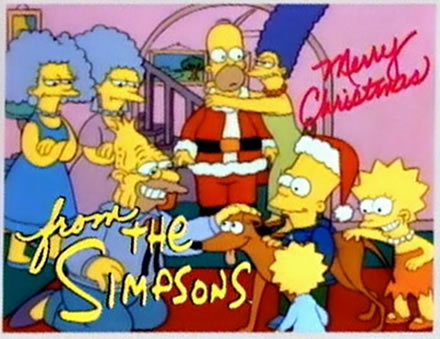
A Quick Review of "Simpsons Roasting on an Open Fire"

Starring: Dan Castellaneta, Julie Kavner, Nancy Cartwright
Director: David Silverman
Created by: Matt Groening, James L. Brooks, Sam Simon


"But he's a loser. He's pathetic. He's...a Simpson." - Homer on Santa's Little Helper

I wanted to do a quick something for the holidays, so I figured the best way to do it would be to briefly review a Christmas special, which also happens to be the series premiere of my favorite TV show of all time.

Saying that "The Simpsons" is my favorite TV show is kind of like saying my favorite ice cream flavor is chocolate (it is, by the way): not everyone would say the same, but it is almost a boring choice. But there is good reason for that: the show has influenced nearly every aspect of our culture and is permanently etched in the minds of all who grew up with it. Some people go to church on Sundays religiously; I would watch "The Simpsons" on Sunday religiously. Heck, I still watch new episodes of it when I have the time. No, it is not nearly as good as it used to be and is done more out of habit and loyalty than anything at this point. But I am not here to talk about that. In the spirit of the season, and to commemorate the 25th anniversary of its original airing (which was before I was born, by the way), I am here to give you my (short) take of "Simpsons Roasting on an Open Fire."

(Warning: I am assuming most of you reading this are fans who have seen this episode a million and one times, but just in case you are not, there will be spoilers).

The episode features the Simpsons running into trouble during the holidays when their sources of income fall through: Homer does not get his Christmas bonus because Mr. Burns is a greed bastard and Marge has to use their Christmas savings to remove a tattoo that Bart got without telling anyone. Homer keeps the former a secret and tries to find ways to make sure his family's Christmas is not a disappointment. This includes getting part-time work as a mall-Santa and attempting to get rich at a dog racing track by betting on a canine with a very familiar name.

By this description alone, it sounds like a fairly typical Simpsons episode, and indeed there are many aspects within it that have carried on throughout the years. However, you will probably notice that this is very much a series under construction. The animation is rather primitive, the voice actors seem very cautious in the way they deliver their lines, and the jokes are generally safe in terms of their content. And while most of the characters are more or less constructed the way most people view them today (especially Bart), others have undergone some noticeable changes since 1989. Ralph Wiggum makes only a brief appearance, but it is hard to overlook the fact that he sounds...uh...not "special." Lisa sounds like, dare I say, a normal 8-year old girl who wants a pony for Christmas. The character who seems most out of place is Homer: aside from the Walter Mattau-style voice (seriously, that is who Dan Castellaneta originally based it on), he seems a lot more straight-laced than he does in later seasons. His intelligence nothing to brag about but not abysmal, his anger seems more abrupt and threatening, and he appears to have a relatively strong moral conscience. When he and Bart go to the race track at the insistence of Barney Gumble (who has blonde hair, strangely enough), he seems genuinely ashamed about it. That's not the Homer Simpson I know! The Homer Simpson I know would have brought the whole family with him and blow their entire life savings on that damn dog!

By the way, does anyone else who has watched this see a lot of similarities between it and "Christmas Vacation"? Both feature the family patriarch failing to turn on the Christmas lights on his house while his family watches on, getting a tree from out in the middle of the woods instead of a lot,  and, yes, not getting his Christmas bonus. They both came out around the same time so unless there was some connection between the two productions, I cannot cry plagiarism for either. My guess is that the Simpsons and Griswold families are only a small faction of people who struggle during the holidays for similar reasons.

But I digress...

In a way, all this makes sense: the show was in the process of evolving from animated shorts that would appear between sketches on the Fox program "The Tracy Ullman Show" to a full-length series. This is not exactly an easy task even today; the creators of "The Simpsons" on the other hand were doing this at a time when Fox itself was just getting started and probably had barely any budget to give them, on top of the fact that there had not been a successful prime-time animated series since "The Flintstones" ended its run twenty years prior. So you can understand if the show seems like it is trying to figure itself out. Still, it is odd to think that this would become the longest-running primetime scripted show in television history; it looks like something that would barely last a half a season today.

As the episode goes on, however, you start to see an inkling of what made the series great. Lisa leaves the pony stuff aside to give a passionate defense of her father as her male role model. Homer meanwhile gets some laughs trying to make the Santa and dog track things work (and failing), with Bart contributing to the mix.

*Spoilers start here*

And then there is the end. Once it seems like rock bottom has been hit, they encounter the dog that Homer lost money on. His name, of course, is Santa's Little Helper, who is adopted by the family as everyone learns WHAT CHRISTMAS IS ALL ABOUT!!! Okay, it is very cheesy and cliche, but it works.

*Spoilers end here*

The Simpsons was always good at mixing humor with heart. I have the quote on top because it is a good synopsis of the episode and to a certain extend the series as a whole: while people (and animals) are flawed, they do their best to rise above it all. Even if they do not succeed, they still manage to find what is really important in life. And hopefully, have a laugh while doing it.

So that is "Simpsons Roasting on an Open Fire." How does it hold up a quarter of a century later? Fairly well. It is not the greatest Christmas special ever, and certainly not the best "Simpsons" episode ever (at least it is not the Worst. Episode. Ev...sorry I could not help it...). Still, it has the Christmas spirit and is, in its own little way, a very appropriate start to a beloved series.

I definitely recommend it if you have not seen it already. And if you have...see it again!

Merry Christmas and Happy Holidays.

The pictures and links on this page do not belong to me and are being used for entertainment purposes only. Please do not sue me,

Monday, December 26, 2011

Dexter Season 6 Review - SPOILERS

No, seriously guys, there are spoilers in this one. So if you don't want anything spoiled for you, I suggest you go finish watching the season before reading my review.


Another year has passed, and with it another Dexter season. Six seasons in is a long time for a TV show, and luckily more people than ever are watching Dexter these days. We got the advertising for this one early on, with the indication that it would revolve around a pair of religious zealots killing people as Dexter tried to figure out his spiritual misgivings and what he wanted to pass on to his 2-year old son Harrison. A year has passed since the events of the emotional roller-coaster season 5, and with it comes a more confident and self-reliant Dexter than we’ve seen in several years.

This was purported to be the darkest Dexter season yet, and I guess you could say it is. The imagery is chock-full of candle-lit churches at night, quivering women, beaten and battered, chained to the wall and dead bodies with black symbols carved into their rotting flesh, and the religious theme is weighty as expected, and handled with Dexter’s usual dark, artistic edge. But the core is, as always, the characters, as each main character has his or her own journey. And there are lots of changes this season, from LaGuerta’s promotion to Captain, Quinn proposing to Deb and Deb becoming the new lieutenant – all in the span of the first two episodes.

Dexter is his usual self, having bounced back from the traumatic experiences from the previous two seasons. He’s witty and stoic and generally we have fun watching his continued attempts to stay out of the limelight with his, erm, hobbies. This season he gets involved early on with Brother Sam (Mos), who is an ex-con-turned-preacher who helps him see a chance for light in him, even through his dark passenger’s hold. Sam is an excellent character, and adds a real presence to the show – he’s a good actor. He and Dexter interact pretty brilliantly, and play off each other well.


Masuka is up to more trickery and he’s bringing in interns to study in the Homicide department. Two of them turn out to be duds, but Louis (Josh Cooke) is a proverbial wiz-kid who knows how to dig deep into the vaults of the internet and turn up info the department couldn’t find otherwise. Cooke is unassuming, innocent and quiet…which makes it all the more startling when his true nature is revealed. I dunno, I guess I kind of saw something coming, but I’m interested in exactly what they do with his character next season. His arc hasn’t been resolved yet, and I think he’s something we haven’t yet seen on the show.

I rather like Quinn’s arc, in which he traverses through a seemingly endless train of drunkenness, humiliating himself and generally being an ass after Deb dumps him. He says he’s “just being a single guy, having fun” but clearly that’s not true, and the dichotomy between what he says and what’s really going on make him a more interesting character than he used to be. Not to mention scenes of him and Batista sharing a dooby in their squad car while on a particularly slow day are priceless. At the end of the season, after several mishaps and clashes, Batista finally puts in a request for a transfer for him, to which he uses a loophole and some cleverly selective wording to pass off his jackassery as a legitimate alcoholism problem – thus able to stay in homicide if he gets help. Clever and underhanded – looks like Quinn’s going back to his old ways. All that stuff from last season about him becoming a better person? I guess that’s just out the window now.


The only real disappointment is the villains, who sound cool and intimidating on paper, but I just don’t think as much work was put into their characters as the drama between our main characters this season. Professor James Gellar (Edward Olmos) and his apprentice Travis (Colin Hanks) are trying to bring about the end of the world by killing people in accordance with several Biblical tableaux. They’re just not that scary, and most of the time I had a hard time taking either of them very seriously. Gellar is incredibly one-note and most of his dialogue is just redundant. Travis almost gets some depth here and there with his sister in the picture, but even that’s just window-dressing.

In the last four episodes, it’s revealed that Travis has been working alone the whole time and Gellar has been dead all along – basically Travis is akin to Dexter; acting with a dark passenger ‘talking’ to him all the time. At this point Travis basically makes the leap of no return and becomes a completely generic ‘crazy’ villain, without much depth or intricacy to his character at all. Too bad I guess.


One thing Dexter has always been good at is creating a great story arc. The flow of the episodes into one another is very natural, creating some great drama. As usual, not every episode is a stand-alone barn-burner, but as a whole, the season has a lot of verve and energy, and everything seems urgent and intense as hell.

One of the standout episodes is ironically the one that departs from the arc the rest of the season is creating. It’s episode 7, “Nebraska,” and it revolves around Dexter going to a nowhere town in Nebraska to confront Jonah Mitchell, the son of the Trinity Killer, who is the only surviving member of the family Dexter interacted with in season 4 – and who is suspected of killing his family. Dexter’s whole story in this season is about his search for faith, and what it means. Brother Sam had been helping him up until this point, but in the previous episode, he was killed, and Dexter, despite Sam’s direct advice to the contrary, murdered the young man who shot him. Armed then with a dark freedom of conscience and the spirit of his dead brother by his side, as opposed to his dead father, Dexter goes to Nebraska to kill Jonah. That along with the cool scenery is a big reason why “Nebraska” rules.


The rest of the season goes swimmingly until episode 11, “Talk to the Hand,” in which the show finally goes where everyone never wanted them to – a romance between Deb and Dexter. Deb, talking to her psychologist, realizes that every guy she’s ever gone out with, including Quinn, is a reflection of her hidden feelings for Dexter, and through a rather icky dream sequence, confirms this. I wouldn’t be so against it if the romance wasn’t horribly contrived. I’m sorry, but for this show’s usual high standards for romance (witness the final scenes between Dexter and Rita in season 4, or the ones with Deb and Lundy early on in the show), lines like “Sometimes everything seems so perfect…and then you’re walking away” are just crap, plain and simple. Even if they are just in Deb’s dreams.

The final episode rules, though, with a lot of great shots, some awesome moments and one of Dexter’s best speeches ever – listen to how badass he sounds; there is no beating that. The man is a legend. And then the show hits us with perhaps its biggest plot twist…Debra’s discovery of Dexter as he’s killing Travis. Dexter looks up, goes soft and says “Oh, god,” and that’s what we’re left with, folks! Damn you, Dexter, for your cliffhangers, as expertly placed and commercially minded as they are! As underhanded as this is, as clearly as it is just calculated to be a marketing ploy to keep people watching, it’s done remarkably well, and fits perfectly with the way the season was going.

So season 6 was another firecracker for the Dexter train as it keeps on rolling. I liked this better than season 5 by quite a bit, as everything seemed to have more energy and power behind it, and all the actors really gave 110% performances. The story, while lacking the subtlety of older seasons, is still good, and I think people complaining about that are overreacting. Dexter in its early days was indeed a more unique show, and had a lot more subtlety and layers to it, with Dexter’s interactions with his victims and various other people as he tried to figure out how to act in general being intricate and idiosyncratic. These days the show goes for bigger, more overt and in-your-face shocks and twists, and it’s safe to say the show has ‘sold out,’ in a manner of speaking – it lacks the old school precise wit and originality in place of a more streamlined action/detective template – but as long as Dexter keeps having seasons this good, I’ll keep watching. Sell-out or not, season 6 is a winner.

All images copyright of their original owners.